Serving the Home Education community.

In Perpetual Motion

How Our Family Works Together in Homeschooling and in Music Ministry

by Heather Fehr

I suspect that our family is like a lot of homeschooling families: continually busy, working at things that are necessary, learning and practicing skills that we think are important, and building things that we love. My husband James and I both had the privilege to receive a home education when we were of school age: James from grades five through twelve, and me from grades ten through twelve. We have been home educating our own eleven children for the last 21 years: seven of whom have completed their formal schooling at home and four that are still working on it. All of our children live at home except for one son who is married to a lovely gal with a precious new son of their own. For now, our older kids are happy to live at home until God leads them elsewhere. They have jobs and contribute financially to help cover costs. Besides homeschooling and outside work, God has also allowed our family to work together as a musical ensemble we call The Fehr Family Band.


When we started out as a couple and then a family, we didn’t plan to have a music ministry, but we did intend to home educate our children. As part of our homeschooling, we decided to incorporate music as one of the non-negotiable subjects that each of our children would participate in. When our oldest daughter was seven and our second child was six, we had the opportunity to enroll them both in a three-year piano music program called Music for Young Children. I went with them each week to the lessons and helped them practice at home. I’d been a piano/voice teacher before getting married and I realized that I could learn how to teach this program and then use it to teach my other children, as well as having outside students come to our home for lessons. Our youngest child, now ten years old, recently finished his three-year program of group music lessons and is now continuing to take private piano lessons. School wasn’t finished for the day until music practice was done. Practicing is still a big part of all of our
children’s lives. If you come to our home during the week, there is a good possibility that you will hear various instruments being played throughout the house, from the laundry room to washrooms to the furnace room and the bedrooms. It’s a pleasant cacophony of musical noise. I love hearing each one honing their skills, developing personal practice disciplines, and seeing
how they grow in character as they are diligent.


As time went on, the children began to be interested in instruments other than the piano. Since they had already begun to learn the language of music, learning another instrument was quite a bit easier. The three older boys chose to learn guitar, mandolin and banjo. After some time learning and practicing on their own, they started to play together. At a time in their life when they were also part of a community handbell choir, they were asked to play a song on their acoustic instruments at one of their handbell concerts. From there, a kind pastor who attended asked if they played for other events. He invited our family to play and sing some songs at a seniors’ get-together. Not long after, two of our girls started to learn violin from a local teacher. Other instruments that various children have learned to play are the cello, tin whistle, flute, Irish drum, harmonica, and ukelele. As everyone’s abilities improved, we were asked more often to play and sing at various events.This pushed us to start incorporating a larger spectrum of arrangements and songs into our repertoire. We would continually try to bring fresh new songs into our setlists for the new events we attended. This allowed us to keep growing in our abilities at a steady pace. We love the growing and stretching this causes! It has been interesting to see how the more music we do, the more we realize that we still have so much to learn.

Soon after we started singing, James’ parents, who used to travel in their own family music group, passed on to us their sound system and trailer for hauling it around. It really helped to learn to run sound for ourselves, although it involved a steep learning curve. We have been able to gradually add to our equipment, as well as use some of it to record a couple of albums. We are just starting to work on a third recording which we hope to be finished this spring. Meanwhile, we have kept diligently working at our schoolwork. We do a more traditional type of schooling in our home. We’ve used a few different programs that are set up with lessons so that I don’t have to do much preparation. School is Monday through Friday most weeks during the traditional school year. We start out each September working toward a set amount of work to be completed by Christmas. Then after a nice holiday break, we get going again in January with plans to be finished our season’s worth of schoolwork by the end of May. We don’t always get it completely finished, but it’s usually close. Then if we still have some left, we can do a little here and there when we have time in the summer. I had almost all of the teaching responsibilities for the first 12 years or so. Since then, as the girls have gotten older, they have helped each other and the younger ones quite a bit. I’m still very involved, but I do appreciate my wonderful helpers. Teaching responsibilities have evolved smoothly as situations have fluctuated, including dealing with health issues for certain ones, and adjusting to new and different busy seasons in our lives.


Summers have been very interesting and event-filled for the last few years. We have had the opportunity to present music at various jamborees and festivals throughout Alberta, Saskatchewan and Manitoba. Our whole family jumps in the van or on our 1975 MCI bus as we travel together to events. We also have bookings on weekends throughout the school year. We love to sing about Jesus and what He can do. We love to make music together. We love to meet new people. And we love to learn and grow, because there are always so many opportunities for that!


A more recent opportunity that has allowed us to grow and learn has been taking on the responsibility for running the annual Deer Valley Meadows Gospel Music Jamboree held at a camp east of Red Deer. It’s been a fun challenge to learn how to run this successfully. This includes booking and working with many different music groups and volunteers, setting up and running sound, booking camp lodging and meals for attendees, buying and serving food for some of the guests, hosting and accommodating the music groups, arranging the event’s three-day schedule, and making promotional materials. This event is a very exciting time for all of us and we look forward to it every year! You can get more info at dvmgospelmusic.com in case you’d like to come and join us!


Many things that we hadn’t planned on have been added to our original home education plan since we first began our journey, but God has paved the way and opened doors. Besides reading, writing, and arithmetic and other standard subjects, we’ve been able to learn a lot about music, instruments, songwriting and arranging, and time management on many levels. With the help of friends and mentors, we’ve learned about sound equipment and its upkeep, as well as bus, trailer and vehicle maintenance and bus/RV renovation. We have made family harmony a high priority – the relational kind more than the musical kind. We’ve realized that there are so many opportunities for education outside of actual schoolwork. We’ve also found that it is possible to do a thorough job of traditional homeschooling while pursuing other interests and hobbies that have turned into a music ministry. It’s an exciting life! We look forward to the new adventures God has in store, and we will keep striving to be faithful in what He has called us to do.

Convention starts Tomorrow!

A discounted offer for the pre-order of the mp3 audio recordings will be available starting Friday morning for a limited time.

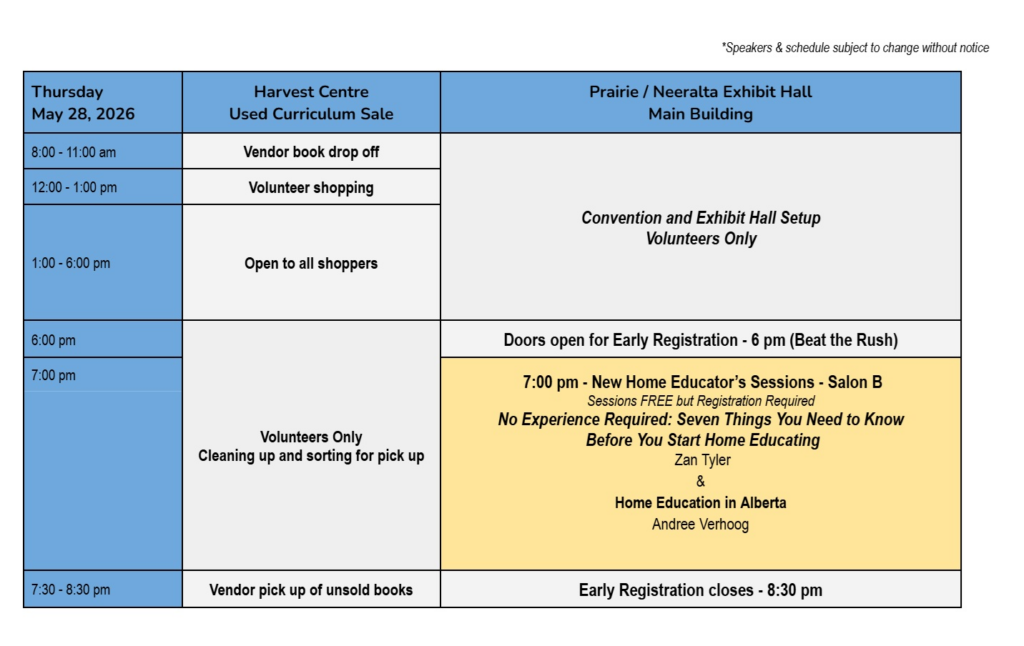
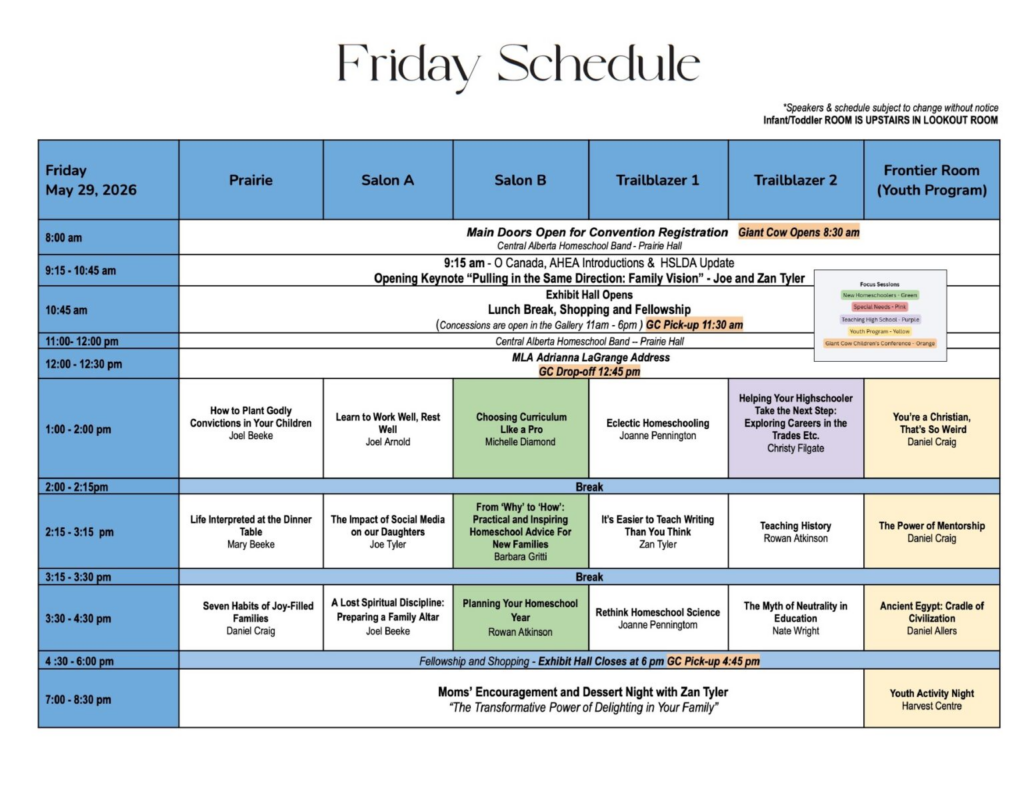
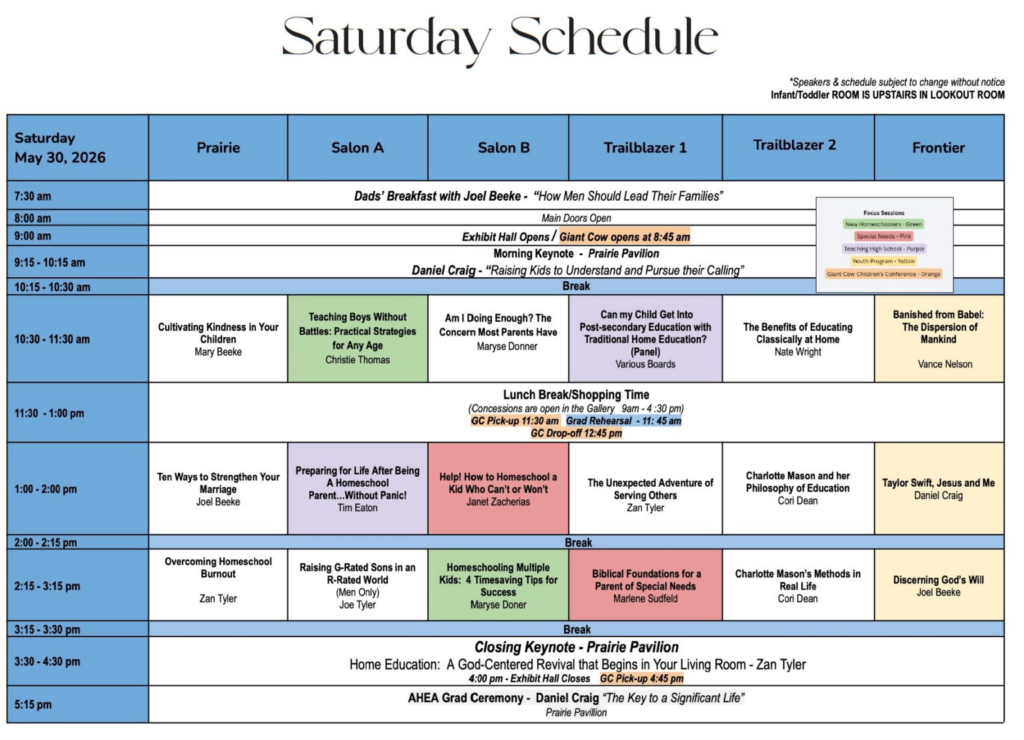
Otherwise, here’s a schedule of events for the next few days

AHEA 2026 Essay Contest

In partnership with the Christian Impact Network, AHEA is putting on an Essay Contest this year!

The first 8 high school students who provide a well written essay (please no help from AI), will be able to attend a May 4 Leadership Summit in Red Deer for free thanks to the organizers. Students can submit a 250 word / 1 page article on why home education is valuable to them both as politically involved and culture driving citizens.

There are free spots at this event for up to 8 high school essay submitters.

Daniel Craig – 2026 Convention

Zan Tyler invites you to the 2026 Convention

Convention 2026 Registration is Live!

Registration is now live for this year’s convention. Early bird pricing is available, and to celebrate our 40th Anniversary we’re offering discounts all around this year.

The Work of Discipleship

by Rachelle Shonwise

Have you ever looked at a day spreading in front of you with a hundred things already clamouring for your attention and wondered what was most important? Or looked back at a day of responding (reacting more often than not in my case) and wondered if the things that demanded your attention were really the most important? As homeschooling moms (and dads, but that’s a perspective I have yet to experience), there are a myriad of urgent things pulling our attention this way and that. There’s the house to clean, run, organize, and maybe even decorate. There are meals to be planned, shopped for, prepped, cooked, served, and cleaned up. There are people to be cleaned, listened to, read to, taught, encouraged, held, and driven to places. There’s schooling planning to be done (or at least thought about), curriculum to be evaluated, bought, and (hopefully) implemented. There are ideas to consider and then communicate. And that’s all without really taking into consideration life outside of our kids and households!

Some days I miss the simplicity of the diaper days– the days when life was crazy, but I knew I’d changed the diapers, read to the kids, and kept them all fed, and that was the most important. Of course, I then remember the struggle of having multiple urgent needs pulling me more ways than I was capable of going, and then remind myself that every stage has its joys and challenges. If the truth be told, it doesn’t matter which stage of life I’m in, I resonate with Anne Morrow Lindburgh when she longs for, “a ingleness of eye, a purity of intention, a central core to my life that will enable me to carry out these obligations and activities as well as I can. I want, in fact—to borrow from the language of the saints—to live ‘in grace’ as much of the time as possible.” Isn’t that what each of us desire on some level? To know what a rich and sustainable life looks like, a life that ends with “Well done, good and faithful servant”?

I think to find that clarity and singleness of purpose we have to start first with the why, and then with the how of our calling. Matthew 28:19-20 says, “Go and make disciples of all nations, teaching them to observe all I’ve commanded you.” Jesus’ final command to His disciples before He left was simply to continue what He had started—making disciples. Every one of us has a mission, and the foundation of every mission is that call to discipleship. When we become parents, our mission field sharpens into focus with our kids as our first priority. While I’ve found that God uses this hidden, intensive discipleship program of parenting to prepare us for a mission field outside the home, as long as we have kids, discipling them is our first responsibility. Our “why” is to fulfill that calling to discipleship.

Discipleship is the act of doing life shoulder-to-shoulder and face-to-face with another, and using that life to point them toward what is good, true, and beautiful, and ultimately, to God. But here’s the kicker. You can only give what you have. You can only teach what you know. And you can only model what you see– what is filling your mental vision. This means our “how” has to start a little closer to home. To disciple well starts with a commitment to personal growth and an understanding of what it means to allow the life of Christ to live through us. To worry less about curriculum and parenting styles and more about keeping
our eyes on Christ.

In essence, a life of clarity and purpose begins with being before doing; with making space to fill our hearts and minds with what is good, true, and beautiful, so we have something to share. I am reminded of Jesus’ interaction with Mary and Martha during His time on earth. Jesus commended Mary’s choice to sit at His feet and learn, to even step out of the bounds of what society found acceptable in order to hear His words and be in His presence. This doesn’t negate doing—on the contrary, our sense of peace and confidence in the doing comes from first being transformed by His presence.

It’s a funny thing really, the fluid nature of time. So often I think I don’t have time to be quiet, to sit and read, to journal and pray, to listen to the still small voice of the Holy Spirit. And yet, when I do take that time, it repays itself tenfold in clarity of purpose, in peace, and in the ability to remember who I am in Christ. So much of my stress is uncertainty and worry about what might happen or what the most important thing is for me to do. Often the thing that is most needful is not the loudest or most demanding action, nor is it often the thing I feel like doing. More often than not I want to DO something concrete and measurable, rather than building rhythms of slow, hidden heart work that don’t seem to bear fruit for years. I was recently challenged and encouraged by this reminder from Reclaiming Quiet:

“We have to live in such a way that knowledge ripens in body as well as mind, in affection as well
as word, as we mold our lives by eternal rhythms and shapes rather than those of a fallen world.
“We are asked to shape our lives, our time, our attention by habits and rhythms radically different
from the windblown fury of the broken world. This means an entirely alternate shape of life, not just
the subtraction of screens and distractions but the embrace of prayer, of daily wonder, of listening, of
trust, of celebration that roots us moment by moment in that deep, watchful quiet that ushers us
into the presence of God.”

Building habits of quiet, of sitting in the presence of God and doing the work of excavating the lies and fears that are bombarding my mind, and then bringing them before Him to be remade is the work. Investing time to find Scripture that speaks truth to the lie I’m believing and worshipping Him for what He says is true (as opposed to what I feel) transforms me and enables me to have something to share with my kids. Sara Hagerty sums this up so perfectly in Adore:

“Adoration is where we bring our raw vulnerability– our ‘what I actually believe about You, God’– to
the place of His truth, expecting Him to change us…Adoration is not an exclusion of our emotions.
Adoration never requires us to shut down our emotions. On the contrary, it invites us to bring
them– all of them– to God. God does not want our polished pretenses. He wants our whole selves,
and He wants us to come honestly. So He invites us to wrestle.”

This is the most important work. Choosing to courageously face our doubts, fears, and questions and doing the hard work of wrestling with God that will allow His life to be lived through our unique personality, circumstances, and family. This doesn’t mean perfection —far from it. Our kids don’t need perfection, they need to see us running with our frailty to Christ.

“(Your kids) don’t need you to be a perfect example of Christlikeness. Your goal is not for them to be your disciple, after all. They need you to point them to the One who is worthy of following. The daily battles of discipling may make you wonder whether you’re toiling in vain. But keep pressing in. You can’t expect a harvest during planting season. Concentrate on reaching the heart of those you’ve built relationships
with, and time will take care of the rest.”

Our job is simply to allow the Holy Spirit to work in us, to faithfully do the work He brings to our attention each day, leaving the outcomes in His hands, and trusting Him when He says, “He who began a good work in you will complete it until the day of Jesus Christ.” May we keep our eyes fixed on Christ, sitting at His feet as a disciple first and then allowing His life to make disciples through us

Rachelle Shonwise is a third generation homeschooler, mom of five boys and one daughter, ages 7-16, and has been married for seventeen years to her favourite person, Josh. They have run a plumbing business for the past fourteen years and are currently transitioning into pastoring the Wimborne Alliance church.
Rachelle loves reading, gardening, and people. Nothing fuels her tank so much as engaging in a good discussion about ideas with others.


Rebecca Spooner RE: This Year’s Convention

Kevin Swanson Re: This Year’s Convention

The Early Years and the First Struggles of AHEA

Michael Wagner

Dave and Aline Stasiewich began home schooling in Edmonton in 1983. That same year they began hosting informal meetings at their house with a small number of other home educating families. The numbers of people attending continued to grow, so the meetings were moved to the Mill Woods Recreation Centre. This group became known as the Christian Home Educators (Edm) Association. It would later adopt the name Home School Christian Fellowship and it continues to thrive.

Back in the mid-1980s many home educators lived in fear due to the hostile climate for people who didn’t send their children to public school. Some home schooling parents were visited by truancy officers, while others had to deal with social disapproval. These were not good times for home education (van der Ahé 2013, 4-5).

Dave and Aline Stasiewich met with the Minister of Education to advocate for home education, but it became apparent that a provincial association for home educators would be helpful in negotiating with the Minister and his Department.

Together with some other parents, Dave and Aline Stasiewich formed the Alberta Home Education Association (AHEA) in 1986. Pioneering home educator Merv Tuplin told this author that Dave and Aline basically initiated the whole thing.

AHEA was officially incorporated on November 26, 1986. The five signers of the request to register the organization under the Societies Act were Gordon Schiffner of Edmonton, Marie Erdmann of Calgary, Nora Harder of Medicine Hat, Carolyn Dykstra of Edmonton, and Stockwell Day of Red Deer. At the time, Stockwell Day was a rookie MLA in the Progressive Conservative government of Premier Don Getty. It is noteworthy that the signers represented many areas of the province.

Willing Non-Resident Boards

After its formation in 1986, AHEA was immediately busy with pressing the government to include provisions for home education in the new School Act. With the passage of Bill 27 (the new School Act) in 1988, the next item on the agenda for AHEA was the home education regulations. The directors of the association urged all members to write and call their MLAs, the Minister of Education, and the director of the Legislature’s education caucus, Halvar Jonson. Many members did call and write, clearly indicating to the government that home educators were concerned. As a result, AHEA representatives were invited to speak to the education caucus. After the AHEA presentation, the minister assured the AHEA directors that they would get some input into the forthcoming regulations (Stasiewich 1988, 1).

AHEA received a draft of the proposed home education regulations on November 4, 1988. The Deputy Minister of Education, Reno Bosetti, then called a meeting for November 15, 1988 for all home educators and their organizations to attend. AHEA urged every member to attend and indicated that the outcome of this meeting was crucial because the proposed regulations were not acceptable:

For all intent and purposes, there is NO PROTECTION for home education parents. The bottom line is that, yes, you the parents have the legal right to educate your children at home, but we, the state, have the legal right to virtually tie your hands if we wish to do so, with time and curriculum requirements. And if you don’t do exactly as we say, we the state, will force your children into an institution of our choice, teaching them the philosophical curriculum of our choice. Alberta Education wants CONTROL of the PROCESS!

AHEA Newsletter 1988, 3

Many home educators did show up for the meeting. Ray Strom writes, “To the surprise of the department officials, the room was jammed with home educators. It was soon determined by those officials that home educators were a determined and serious group” (Strom 2003, 5).

The Home Education Regulation was released on February 28, 1989. AHEA immediately began trying to identify willing non-resident boards. Dave Stasiewich wrote to the members:

Please let me know of any board that is very reasonable towards home schooling and wants to co-operate. We want to publish all the boards that we know of that are interested in home schoolers and want to co-operate with us in our next newsletter. The directors of the Association will also be contacting school boards and discussing home school arrangements with them.

Stasiewich 1989, 1

The search for willing non-resident boards turned out to be a very difficult task. Apparently, there was a kind of peer pressure among the boards not to accept students from other jurisdictions. A board that did accept students from other jurisdictions would be considered a “skunk in the chicken coop,” as Ray Strom put it. Thus home educators were stuck with their resident boards, many of which were unfavourable.

It wasn’t until 1991 that a breakthrough occurred. In September of that year AHEA discovered that the Assumption Roman Catholic School District #50 in Oyen was open to being a willing non-resident board. Harold Elias and Ray Strom from AHEA spent a considerable amount of time negotiating an agreement with that board. AHEA then prepared a notification form to be filled out and faxed to Assumption. With only three days remaining before the deadline for notifications to be received, over 100 students notified with that board (Strom 2003, 6).

This was the turning point. Notifying with a willing non-resident board was no longer just a legal possibility but a genuine reality. But entrenched interests were not pleased by this breach in the dyke. As Ray Strom related,

The repercussions were stupendous, with school boards crying with outrage, and the Department immediately jumping all over the Assumption district, trying to find loopholes to shut them down. None were found, thankfully. The dye had been cast, and there was no turning back.

Strom 2003, 6